
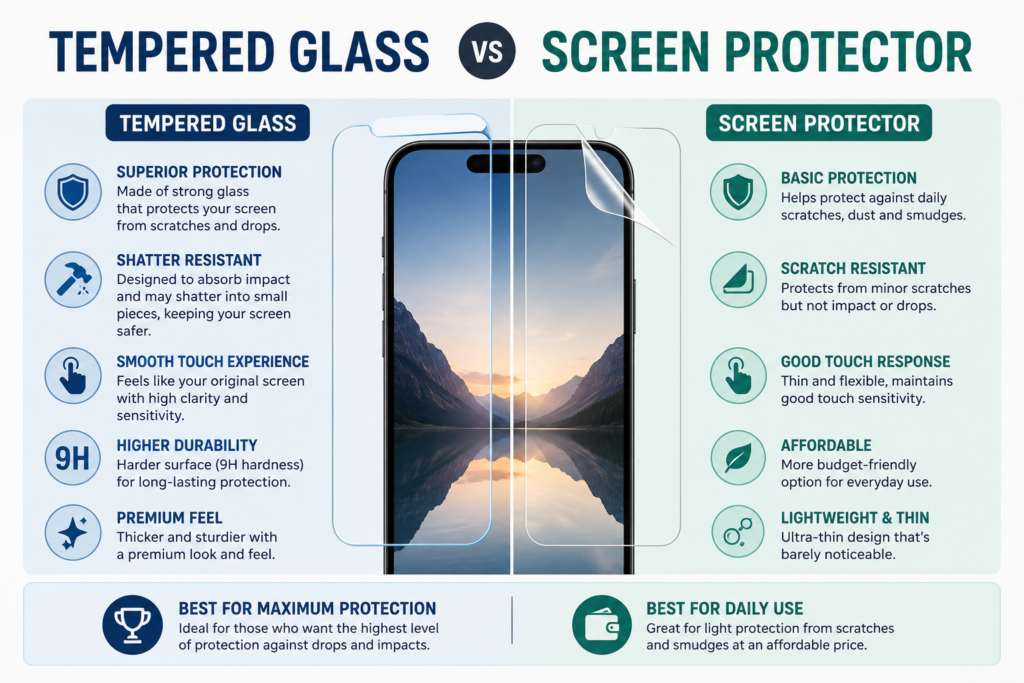
In today’s digital world, smartphones, tablets, and other electronic gadgets have become like a daily lifeline for most of us. And since these things can be pretty expensive, guarding their screens is usually priority number one. One question people keep asking is, Tempered Glass vs Screen Protector – which actually gives better protection?
Both tempered glass and screen protectors are made to help keep your device display safe from scratches, cracks, and that constant little wear-and-tear. Still, they’re not the same. They tend to vary a lot in terms of durability, how much protection they truly provide, how the installation goes, and the overall feel you get while using the phone.
In this guide we’ll sort out Tempered Glass vs Screen Protector, step by step, so you can pick what fits your device best, without second guessing later.
What Is a Screen Protector?
What even is a screen protector
It’s basically a thin film of plastic that you stick right onto your device’s display. Most regular ones are often made with polyethylene terephthalate (PET) or thermoplastic polyurethane (TPU).
The point of these protectors is mostly to guard against tiny scratches, smudgy fingerprints, and small scuffs, ya know. They also stay lightweight, cost fairly little, and they’re pretty simple to swap out when they get messed up.
Advantages of Screen Protectors
Affordable, kinda budget friendly
They come in thin and light weight designs
They guard the display from scuffs, and dust
They feel flexible, and they are quite easy to stash
There is usually a version for almost every device out there
Disadvantages of Screen Protectors
Impact protection is limited, so drops are still risky
During installation they can end up with bubbles, sometimes
Over time the screen clarity can dip a little
You might notice a less smooth touch feel
What Is Tempered Glass?
Tempered glass is a specially treated piece of glass that goes through a heating and then cooling process, basically to up its strength . Compared to regular plastic screen protectors it tends to be way tougher, and it gives better coverage when you drop it by mistake, or when small impacts happen.
Most tempered glass protectors come with a hardness rating of 9H. So it resists scratches from keys, coins, and other hard objects pretty well.
Advantages of Tempered Glass
– Superior shock defense, it helps against falls
– Noticeably stronger scratch resistance
– Crystal-clear screen clarity, very crisp display quality
– Smooth touch responsiveness, feels more natural
– Easier setup with less chance of bubbles, in most cases
– Feels almost exactly like the original screen
Disadvantages of Tempered Glass
– Costs more than plastic protectors
– Usually a bit thicker in the layout, so it sits differently
– Can fracture after one serious impact, sometimes unexpectedly
– Might not align perfectly with certain phone cases, depending on the edges
Tempered Glass vs Screen Protector: Key Differences
Let’s compare the two options based on important factors.
1. Protection level
When we talk about tempered glass vs screen protector, protection is the big thing, like honestly the most important factor.
Tempered glass gives great defense against drops and impacts. It kind of drinks up the shock , and usually breaks on purpose so your phone’s real display stays safe.
Meanwhile , standard screen protectors mostly help with scuffs, scratches, and small everyday wear. They are not built for real impact events , like a real fall.
Winner: Tempered Glass
2. Scratch Resistance
Modern smartphones get bumped with keys , coins, and all kinds of rough stuff every day. Tempered glass helps way more with scratch resistance , since its surface is hardened .
On the other hand, plastic screen protectors can end up with scratches quicker and then you might see clear marks after longer use, kind of like a worn veil.
Winner: Tempered Glass
3. Touch sensitivity
You really want a smooth, responsive touch moment for smartphone users.
A tempered glass panel tends to feel very close to the original screen, so swiping, and typing feels more natural , not jittery.
Meanwhile, plastic screen protectors can occasionally feel kind of rubbery or a bit sluggish, mainly on lower quality versions.
Winner: Tempered Glass
4. Display Clarity
One big factor in the Tempered Glass versus Screen Protector debate is just screen visibility, overall.
Tempered glass tends to give excellent transparency and keeps the display’s original brightness and color correctness.
Meanwhile, some plastic protectors can slightly blur or soften the screen sharpness, and they might get cloudy later on.
Winner: Tempered Glass
5. Installation process
Putting on a screen protector can be annoying, like really, especially when little air bubbles show up under it for no reason.
Tempered glass is usually easier to install since it’s rigid, so it lines up more cleanly with the display.
Plastic protectors are a bit more demanding, you need extra care, and they often cause those bubbles if you don’t apply them slowly and carefully, and well.
Winner: Tempered Glass
6. Price
Screen protectors are usually way cheaper than tempered glass variations, honestly.
If you’re trying to get simple defense while you’re on a tight budget then a plastic screen protector is a very cost effective choice.
Tempered glass may cost more but it tends to provide noticeably stronger protection.
Winner: Screen Protector
Tempered Glass vs Screen Protector for Different Users
For Students
Students often carry their phones in backpacks along with books and stationery. Since accidental drops are common, tempered glass is usually the better option.
For Office Professionals
Professionals who use their phones frequently for work may appreciate the premium feel and clarity of tempered glass.
For Budget-Conscious Users
If your primary concern is preventing scratches rather than impact damage, a screen protector can save money while offering basic protection.
For Gamers
Mobile gamers benefit from the smooth touch response and better screen visibility provided by tempered glass.
Common Myths About Tempered Glass and Screen Protectors
Myth 1: Tempered Glass Makes Your Phone Unbreakable
Look, no screen cover can promise 100% safety. Tempered glass can cut down the chance of screen damage, but it still can’t stop every kind of breakage, not even close.
Myth 2: Plastic Screen Protectors Are Useless
Sure, they don’t handle heavy impacts very well. But screen protectors are still useful, they help a lot with scuffs, micro-scratches and regular day to day wear.
Myth 3: Tempered Glass Reduces Touch Sensitivity
This one is kinda exaggerated. A good tempered glass keeps solid touch response and often feels the same as the original display, like literally identical to most people.
Myth 4: All Screen Protectors Are the Same
They are not the same at all. Different materials, different thickness, and different manufacturing methods change how they perform, so the protection level varies from one to another.
Which One Lasts Longer?
When you compare Tempered Glass to a Screen Protector , tempered glass tends to hang around longer , because it resists abrasions better and keeps its clarity more or less steady over time. Meanwhile , plastic screen protectors usually age faster, and they might need a more frequent swap—like sooner than you’d expect.
On the other hand , if tempered glass takes a strong blow, it can fracture , and then you might need to replace it right away .
How to Choose the Right Option
Go with tempered glass if
You often drop your phone, even like once in a while.
You want the most screen protection.
You like a premium kind of touch feel.
You’re using a high-end smartphone.
You care about better display clarity overall, not just “ok” viewing.
Choose a screen protector if
You are working with a tight budget.
You mostly only need scratch protection, nothing more dramatic.
You prefer a very thin protective layer, almost discreet.
Your device is seldom exposed to impacts, like it mostly stays in a bag or pocket.
Final Verdict: Tempered Glass vs Screen Protector
So the winner in the Tempered Glass vs Screen Protector comparison is kind of based on what you actually need, like if you care more about feel or the best kind of defense. But for most phone users, tempered glass tends to be the better call, mostly because it gives sturdier protection, smoother touch sensitivity, clearer screen visibility, and overall more durability.
Now yeah, classic screen protectors can still be a budget-friendly option, but they don’t really keep up with the impact resistance and the overall performance you get from tempered glass.
If you went and paid for an expensive smartphone, then spending a little more on tempered glass is often worth it. It can help avoid those expensive screen repairs, and also keep your device looking fresh for longer, like a quiet upgrade without the whole drama.
In the end, whether you go with tempered glass or a screen protector, using some kind of screen shield is always better than leaving your display out there for scratches, cracks, and accidental damage, which honestly happens faster than people think.
Conclusion
When looking at Tempered Glass and Screen Protector, the tempered glass option kind of wins for most folks because it has better toughness , stronger resistance to impact, and that more premium touch feeling. It helps a lot with accidental drops, daily scratches, and general wear and tear. At the same time it keeps the original look and feel of your device display pretty much intact.
Then again, a regular screen protector is more budget-friendly, and it’s made for simpler things like basic scratch defense with a slimmer, lighter kind of profile. Sure, it doesn’t usually protect like tempered glass does, but it can still do its job by keeping your screen safer from small, everyday bumps or minor damage.
In the end, the best choice really depends on what you want and how much you want to spend. If you care about the most protection, tempered glass is the obvious winner. If affordability is what you’re after, and scratch prevention is mostly what matters, then a screen protector works as a practical solution. Either way, putting a screen protection layer in place is a smart move, and it can help extend the usable life of your device.